Spiraling Past Perfection
I was about 10 years old, spinning around myself in the stage right corner of my dance studio on a sunny spring day. The sun was shining through the windows, illuminating little orbs in my vision. I gaze at myself in the mirror as I spin around. I’m not sure if it was some form of undiagnosed OCD or the perfectionist in me, but anytime I spun around over my right shoulder, I forced myself to subsequently spin that same amount over my left. I worried that one day when I died, I would have spun too many times towards one direction and not enough to the other, making me uneven. If I was unevenly spun, then I wouldn’t fit into my perfectionist ideology. I was in the back corner of the room spinning around in circles over my left shoulder after doing jazz pirouettes over my right just to make sure I was evenly spun. I didn’t appear to be crazy though, because we spun around in circles all of the time; it's part of the art of dance.
I started dancing when I was three, and I haven’t stopped since. As a child, I only danced ballet and tap, but as I grew older, I started doing competitive dance. From age twelve through sophomore year in high school, I focused solely on competitive dance. By sophomore year, I was competing in jazz, hip hop, and contemporary dance for both my dance studio and my high school’s dance team. From junior year onward, I focused on ballet while doing my high school team. I was always better at ballet than any of the other styles of dance, but I also just really enjoyed ballet. I still do! I love the structure of the technique and the visual beauty of it. I love how it’s never ending, and there’s never abrupt stops. My ballet teachers always told me to move continuously, and connect the steps as if they’re all one fluid motion. According to an academic article from 2024 by Ronald Hubner, “It is now widely accepted among researchers and designers that a curve is beautiful or, as they call it, fair, if its curvature does not change abruptly”. Curves and spirals occur in both nature and art, and they’re objectively beautiful shapes. When curves continue in their natural spiral shape, they’re more admirable and aesthetically pleasing to the eye. The curved shapes in ballet never end, as they are danced in one continuous motion. Even the lines that appear sharp and straight in ballet are actually curves. My ballet professor, Valerie Huston, always reminds us of the plethora of curves found merely in an arabesque.
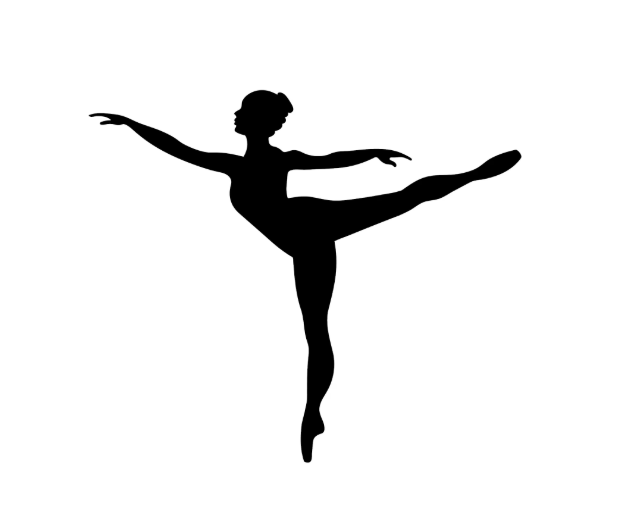
The image above shows the position called first arabesque. The elongated arm above the nose is the same arm as the “supporting leg”, which is the leg that is still connected to the floor. The leg behind the dancer is considered the “working leg”. Valerie Huston claims that there is a curve from the head to the back leg, the front arm to the supporting leg, the supporting leg to the working leg, and front arm to the working leg. If we really dissect this position as well as all other positions in ballet, it becomes apparent that the structure of ballet is based around curves and spirals. Not only is ballet visually curved and spiraled, but it feels that way anatomically in the body, as well. When I’m in the arabesque position, I often think about the head to back toe spiral as a way of sustaining the position and making it more visually appealing. Similarly, the movement of the arms is called port-de-bras in ballet. This French word translates to “carriage of the arms” in English, and it encompasses the shapes we make in ballet and the relationship of your arms to the rest of your body. Any time my body is executing any sort of port-de-bras, I can feel my arms spiraling from my back to my fingertips. The arms also work as a balance assistant when placing them on your plum line to keep your center of gravity stable. The accentuated curves of the arms are not only beautiful to watch, but they also feel efficient in the body.
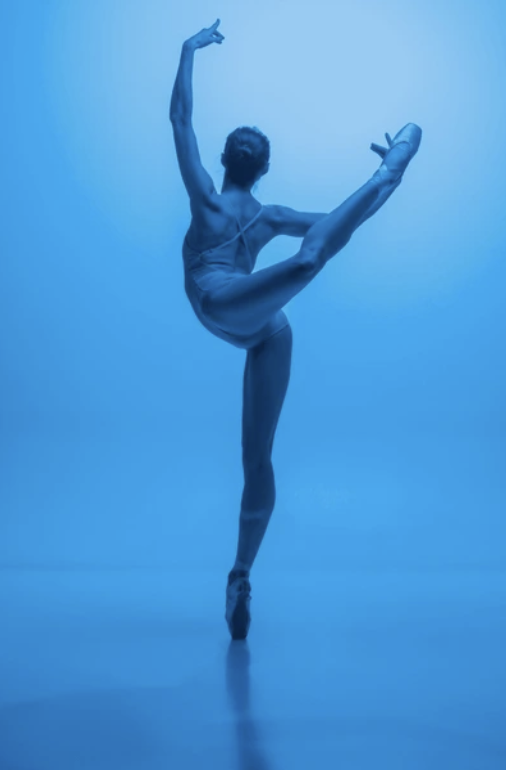
Valerie Huston believes that the reason that ballet has lasted so long isn’t because the dancers are beautiful and wear tutus, but rather, because the structure is related to the DNA double helix. This spiraling figure that we know as the double helix of our DNA replicates the continuous spiral that is found in nature. Every position in ballet is continuous and connects in the same shape as the double helix, specifically in the position called “back attitude”. In this position, the spiraling helix can be seen very clearly. The head to toe connection, as well as the arm placement, clearly demonstrates this spiraling effect. The position is an endless loop of energy. In ballet class, I often envision the DNA double helix as a way of materializing the spiral of the shape. The human body is filled with the spiraling DNA, and art like ballet mimics this shape. DNA is a spiral that resembles the spiral of the Fibonacci sequence.
We’ve all likely heard of the Fibonacci sequence: the sequence of numbers in which each of the numbers are a result of the sum of the two preceding numbers. When placed on a graph, these numbers resemble a spiral. When I think about spirals, this is the first spiral that comes to my mind. Spirals not only occur in art and math, but in nature as well. According to a book titled Spirals and Vortices: In Culture, Nature, and Science, spirals occur in both living and non-living nature, and some “examples of the non-living nature some spirals and vortices of various sizes are selected: spiral galaxies, hurricanes and tornadoes, aerodynamic turbulence, crystal growth on surfaces and carbon nanotubes. In the realm of living structures, we consider rigid spiral forms (for example, seashells and snails), as well as flexible ones like the tail of a chameleon or a sea horse”. This mere list reminds us of the recurrence of spirals in many realms of nature, and this list doesn’t even include all of the possibilities of spirals in nature.
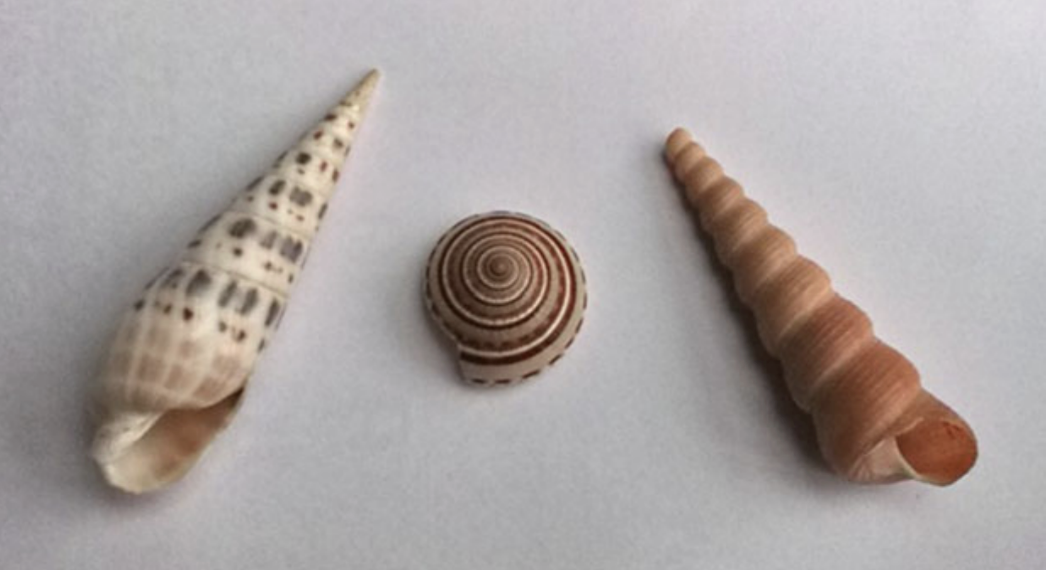
These seashells pictured are so beautiful yet so common.
You could take a short walk on the beach and surely you’d find other shells that look just like these. The spiral looks so even and symmetrical, and yet it was made through natural creation. These spiral shapes are also found on snail shells. Growing up, I was strongly drawn to snails. I used to play with them at school, and my closest friend often made fun of me for how much I loved those slimy pests. I even asked for a snail stuffed animal for Christmas one year. The shells are each so beautiful and original, and their natural design is so captivating. I’m sure that their spiraling shells was a driving factor of why I was so attached to snails. The prevalence of spirals is unquestionable, but I often wonder why they’re so universal.
Spirals often occur in both nature and physical manifestations due to efficiency, function, and aesthetics. As I mentioned before, ballet’s spiraling nature is visually pleasing and also functional as a dancer. Visualizing the spiral of the shapes while physically embodying them assists with balance and structure. YouTube channel Bright Side says that the DNA helix is shaped in a spiral as a way of storing a plethora of genetic information in a confined space. Similarly, the seeds of a sunflower are placed in a spiral formation so there's an even distribution of sunlight to each seed. Artists often play with spirals because they are “hypnotizing” to the human eye. The functionality, efficiency, and aesthetic qualities of spirals are a great way for us to decipher why a spiral is such a prevalent shape. Spirals may be common everywhere, but they're especially prevalent for me.
I mentally spiral all of the time. Whether it’s convincing myself that my skin imperfections are the effects of a life threatening disease or deciding that it’s detrimental when a waitress tells me to enjoy my meal and I say “Thanks, you too”, my problems always seem to expand and spiral relentlessly in my brain. Spiraling is a common cycle for me and it happens often throughout my days. Even when I go to bed at night, I often plan out my mornings by the minute so that I can be as efficient as possible in the early morning. This form of spiraling may be efficient, but most of the time, my crash outs aren’t so efficient. When this spiraling happens, it is unlikely for my family and friends to be able to pull me out of the endless loop that my brain confines me in. I’ll talk to my mom about my problem of the day and she offers me solutions, to which I give another reason why that solution is inaccurate or not valid. When I spiral in front of my roommate and deny every reassurance she gives me, she often says “Okay Reese, I don’t know what to tell you”. There really isn’t any form of reassurance that can pull me out of these spirals. They are endless spirals that darken as they expand. Opposingly to the spirals that occur in nature and art, my emotional spiraling episodes aren’t beautiful nor functional. Instead, they're momentary anxious losses of control that eat me alive.
I don’t spiral because it’s efficient or aesthetic, but maybe because I ultimately realize that I’ll never be evenly spun. When I die, I’ll likely have spun too many times to the right because my right pirouettes are better than my left. My arabesque will never be as high as I want it to be because as soon as I gain flexibility, I’ll have made bigger goals for my arabesque. I will never be as clean as I’d like to be, even when I shower three times a day. Every once in a while, I’ll sit on my bed with outside clothes on because I’m exhausted. Nothing in my life will ever be perfect, because perfection doesn’t exist. The calculated nature of the spiraling Fibonacci sequence looks perfect, but the actual numbers of the sequence are not considered perfect numbers mathematically as their divisors aren’t the sum of those numbers. The spiraling of our blood vessels throughout our bodies won’t even be perfectly symmetrical. Perfection is unattainable and non-existent because perfection is subjective. Spirals, though, are widely considered beautiful, and their prevalence in art and fashion is undeniable. My new favorite pieces of jewelry are a bracelet, ring, and necklace that all have spirals on them. They're my new obsession, and I’ve been curious why I’ve been so drawn to them. When I think about the beauty and functionality of ballet that I love so much, my love for nature, and my perfectionist mentality, my obsession with spirals becomes clear. Spirals allow me to escape my mind. They allow me to give up control, and just immerse myself in the continuity of them. I can look into a spiral for as long as I want, and allow my brain to get lost in the endlessness. Just like the circle of life, spirals keep moving even when you don’t feel like moving. They're consistent and predictable, just as all of my favorite things in life are. We may never know why spirals are so ubiquitous, but knowing that they are makes me feel at peace. I’ll never be evenly spun, but I’ll always have the choice to spin away from the ideal.
Works Cited
Hübner, Ronald. “Golden spiral or fibonacci spiral: Which is more beautiful and why?” I-Perception, vol. 15, no. 2, Mar. 2024, https://doi.org/10.1177/20416695241243319.
Huston, Valerie. Notes from various ballet classes. 2022-2025.
Tsuji, Kinko, and Stefan C. Müller, editors. Spirals and Vortices: In Culture, Nature, and Science. Springer, 2019.
“Why Our World Is Filled with Spirals.” YouTube, Bright Side, www.youtube.com/watch?v=Y-2NTYEoh4U. Accessed 15 June 2025.